IUCN WCC: Motions for the Deep Ocean
Deep sea conservation was on the agenda last week, as the International Union for the Conservation of Nature (IUCN) World Conservation Congress (WCC) took place in Abu Dhabi, UAE. The WCC is the world’s largest gathering of government leaders, Indigenous Peoples, scientists, advocates, and civil society members promoting nature conservation.
The IUCN is a multilateral association of member organizations, Indigenous groups, and governments from around the world, whose primary purpose is to promote the conservation of nature for the benefit of biodiversity and people. The IUCN WCC, which meets once every four years, is an opportunity for the Union to gather and determine its agenda for the next few years, primarily by voting on motions.
IUCN motions – which, once passed, guide the organization’s policy and influence global conservation efforts – call upon both IUCN members and the IUCN Director General and Commissions to adhere to and advance action. Motions can focus on a range of issues, such as the protection of key ecosystems and species, measures to mitigate and adapt to climate change, and the inclusion of human rights in nature conservation efforts.
At this year’s IUCN WCC, two proposed motions focused on the protection of an often overlooked area of biodiversity – the deep sea.
In the last few decades, initiatives to understand and protect deep sea ecosystems (containing an estimated 95% of the liveable space on the planet) have been growing. We now know that these areas are home to immense biological diversity and play essential roles in the ocean’s capacity to regulate climate, support marine food chains, and contribute to the overall health of the planet. Protecting the ocean from seabed to surface should be at the heart of global efforts towards protecting at least 30% of the ocean by 2030 (30×30), and Motions 032 and 035 put this into practice.
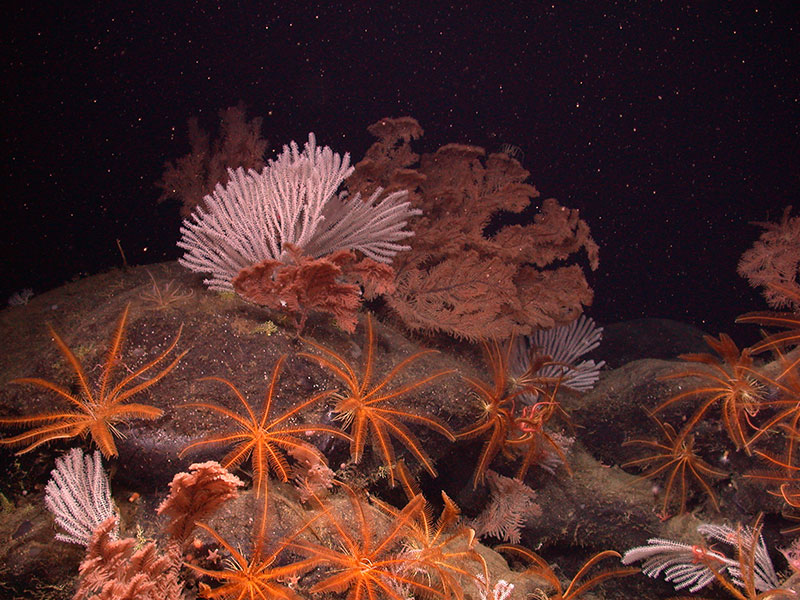
Motion 032: Protecting seamounts and vulnerable marine ecosystems from destructive practices, sponsored by World Wildlife Fund (WWF) Australia and championed by the Deep Sea Conservation Coalition (DSCC), called for the protection of seamounts, soaring underwater mountains bustling with life. These deep sea ecosystems, found across the global ocean, have been targeted by destructive fishing activity, such as bottom trawling. Alarmingly, such practices are still permitted today. The ongoing destruction of these fragile oases of life was what Motion 032 sought to end.
Motion 035: Protection of mesopelagic ecosystem integrity, sponsored by Marine Conservation Institute in partnership with the Environmental Defense Fund and Ocean Conservancy, called for applying a precautionary approach to the expansion of activities – including fishing, deep sea mining, and geoengineering – that may have adverse impacts on the mesopelagic zone (or “Ocean Twilight Zone”), a critical layer of the ocean that stretches from 200 to 1000 meters beneath the surface.
HOW DID THE WCC MOTIONS CALL FOR OCEAN PROTECTION?
These motions aimed to secure protections for biodiversity in the deep sea. Though mesopelagic and seamount ecosystems are different, they are inextricably linked. The threats they face vary in their current levels of impact, past international precedents, and scientific understanding as to the impact these threats pose to marine biodiversity.
Motion 032 called on the IUCN to promote the protection of seamounts when engaging with regional fisheries management organisations (RFMOs), states, and multilateral agreements, as well as implement past resolutions preventing adverse impacts on vulnerable marine ecosystems, such as seamounts, as a result of bottom fishing activities on the high seas. The motion also calls for the IUCN to support the protection of seamounts, seamount networks, and species associated with seamounts and, specifically, to activate a transition away from bottom trawling on seamounts by the end of 2026.
Above the seafloor, the “twilight zone,” or mesopelagic zone, spans the entire portion of the water column from 200 to 1,000 meters deep, where light starts to filter out. This area teems with an astonishing diversity of life, where many creatures have evolved remarkable adaptations like bioluminescence to survive. Though this zone represents only 20% of the ocean by volume, it is thought to contain upwards of 90% of the planet’s fish biomass. Every single night, in the largest known migration of animals on the planet, the species in the mesopelagic rise to the surface to feed before returning to the depths, transferring between 2-6 gigatons of carbon from the surface waters to the deep sea. The life in this zone thus plays a critical role in the ocean’s biological carbon pump, supporting the ocean’s capacity to regulate climate. From an ecological standpoint, many of the species in this zone are important prey for commercial species such as tuna and swordfish.
Unlike seamounts, the mesopelagic zone does not currently experience significant extractive activity. There is, however, growing interest in expanding industrial fishing at this depth primarily for fisheries that would target small, abundant fish such as lanternfish for use as sources of fish oil and fish meal to be used in products such as aquaculture feed, pet food, and health food supplements. Other activities, including deep sea mining and geoengineering, could pose additional future threats to life in this zone as they expand, causing toxic sediment plumes and excessive nutrients harmful to marine life. Any increase in sediment plumes in particular will negatively impact species reliant on filtering food or bioluminescence to survive in this region.
Motion 035 called for applying a precautionary approach to the assessment and regulation of activities that may have an impact on life in the mesopelagic zone, and urged the IUCN and its members to champion the importance of the mesopelagic’s role in climate. The Motion also sought to incorporate protections of the mesopelagic zone into area based management tools such as marine protected areas (MPAs), support further research and environmental assessments of how activities occurring in this zone could lead to impacts on global climate and ecological stability, and incorporate these considerations into future UN General Assembly resolutions.
WHAT HAPPENS NEXT?
After several days of negotiations and deliberations, both Motions 032 and 035 reached a consensus text and were adopted as resolutions with an overwhelming majority during the Member’s Assembly at the IUCN WCC.
These IUCN resolutions mark an exciting moment for deep sea conservation. As policy statements, they will guide the actions and priorities of IUCN members and commissions, and set precedent for future motions and resolutions to build upon. IUCN resolutions also hold considerable weight when setting global policy agendas outside of the Union, and can lead to decisions, policies, and resolutions in other global frameworks, including at the UNGA.
With the recent ratification of the Biodiversity Beyond National Jurisdiction (BBNJ) Agreement or “High Seas Treaty”, both of these resolutions draw attention to the importance of establishing MPAs on the High Seas that include protections for the entire water column, as both seamounts and the mesopelagic zone exist both in national waters as well as in the area of the ocean beyond any country’s jurisdiction, or the High Seas.
Motion 032 builds on over two decades of UNGA resolutions and legal obligations in the 1995 UN Fish Stocks Agreement that require States and RFMOs to prevent the significant adverse impacts of bottom fishing on vulnerable marine ecosystems, including seamounts, while noting that these obligations remain unfulfilled.The UN Bottom Fisheries Review in 2026 will mark 22 years since the initial agreement for protections was supported, and reflect on progress made during this time. The adoption of Motion 032, and the strength of its call for action, sets a time-bound goal which can, and must, be achieved when states convene at the Review next summer.
FROM MOTIONS TO ACTION
The deep sea has long been out of sight and out of mind for those in the position to drive meaningful conservation action, but the tide is changing. Motions 032 and 035 – now resolutions – brought attention to the unique ecosystems on seamounts and in the mesopelagic zone and will guide future IUCN policy to conserve the deep sea. While these resolutions set important precedents as to how to approach protecting these areas, they must be followed by concrete actions and integrations into international legally binding mechanisms. Ambition for ocean protection must reach from the seabed to the surface, and these resolutions are the perfect place to start.
Header image: Davidson Seamount, CA – Credit – NOAA:MBARI


About the authors
Dr. Lance Morgan is the President of Marine Conservation Institute with a PhD in ecology from the University of California Davis. Lance has long been involved in efforts to safeguard deep sea species with his efforts to protect deep sea corals on seamounts off the California coast. Lance currently serves on the Board of the Deep Sea Conservation Coalition and is a member of the High Seas Alliance steering committee. He oversees the major initiatives of Marine Conservation Institute: Blue Parks, Marine Protection Atlas, and High Seas Conservation.
Elle BentElle Bent received her M.A. in International Environmental Policy specializing in Ocean and Coastal Resource Management from the Middlebury Institute of International Studies. Elle has worked with Marine Conservation Institute for the past year, and has been involved in work to advance High Seas marine protected areas under the newly ratified BBNJ Treaty, including by working on Motion 035 to secure protections for the entire water column.
Related content
 Four years to 2030: scaling effective ocean protection
 The legal fight for Europe’s marine protected areas
 A Turning Point for Ocean Protection in Ghana
Share this article
using #ForTheOcean