11th Our Ocean Conference
The world has committed to protecting at least 30% of the ocean by 2030. The ambition is clear. The challenge now is delivery.
With less than five years to go, progress is not keeping pace with what is needed. Too much protection still exists only on paper. Too many marine protected areas lack the funding, enforcement, and local leadership required to deliver real outcomes.
The Our Ocean Conference (OOC11) was a critical moment to change that.
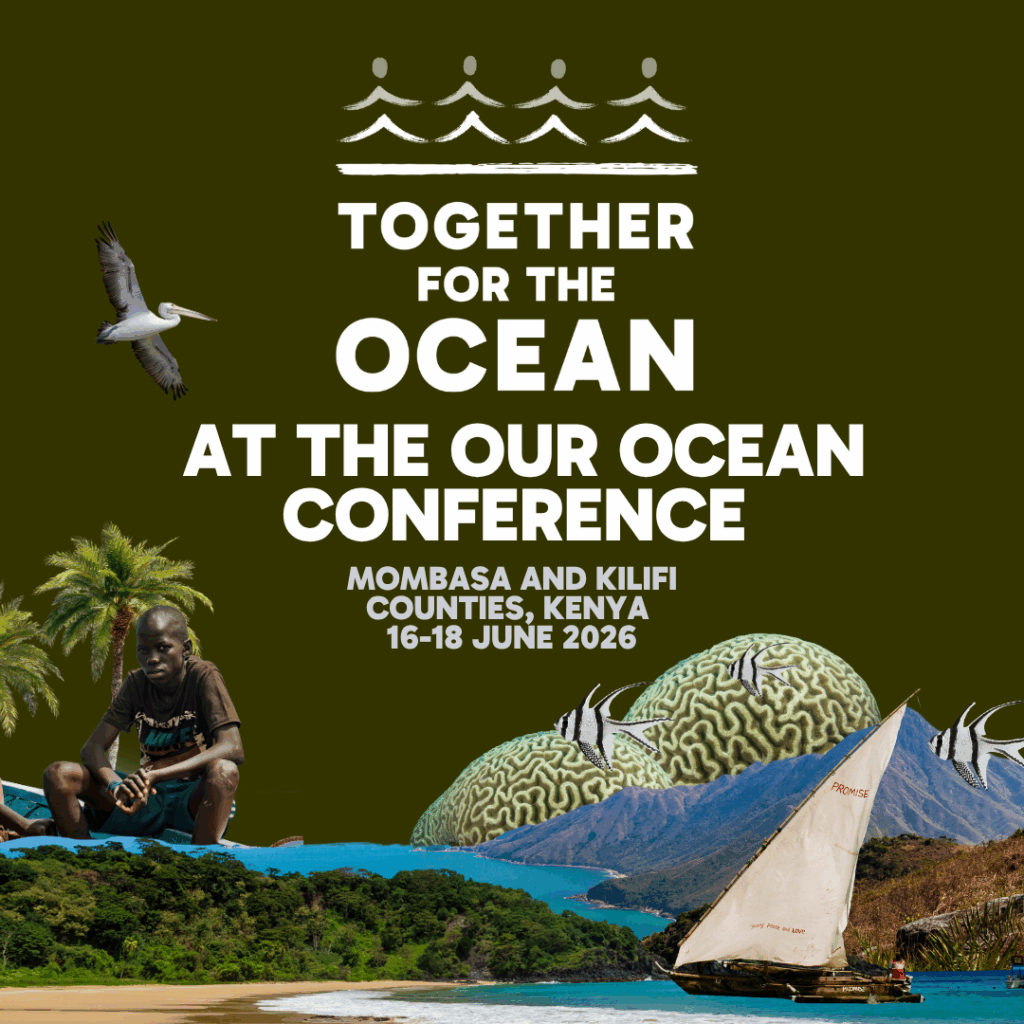
Hosted in Kenya under the theme of heritage, the conference provided a powerful opportunity to elevate African leadership and locally-led action, demonstrating how effective marine protection delivers benefits for nature, economies, and communities.
African nations have played an important role in advancing global ocean protection and continue to shape the international agenda.
Kenya illustrates both the opportunity and the challenge of delivering 30×30. While less than 1% of its national waters are currently designated for protection, the country has strong foundations for locally led marine conservation. Community-led initiatives, such as locally managed marine areas (LLMAs) in northern Lamu, are demonstrating how effective protection can support biodiversity, fisheries, and coastal livelihoods.
FROM COMMITMENT TO ACTION
At OOC11 in Kenya, Together for the Ocean united partners, decision-makers, and local leaders to:
- Close the implementation gap and accelerate real protection in the water
- Mobilize sustainable finance to support long-term ocean conservation
- Champion locally led solutions that work for communities and ecosystems
Because delivering 30×30 will not happen through ambition alone. It requires coordinated, accountable action.
WHAT WE CALLED FOR
At OOC11, Together for the Ocean called on governments, financial institutions and partners to:
- Scale up protection that is effectively managed and enforced
- Close the funding gap with long-term, accessible finance
- Put people at the center, supporting Indigenous Peoples and coastal communities
- Deliver on 30×30 with transparency and accountability
TRACKING PROGRESS AND STRENGTHENING ACCOUNTABILITY
Achieving 30×30 requires more than commitments; it requires transparent tracking of real progress over time. The Together for the Ocean Marine 30×30 Data Dashboard gives policymakers, journalists, civil society, funders, and ocean stakeholders access to the latest data on marine protection, finance, High Seas Treaty ratifications, and biodiversity commitments at global, regional, and country levels.
By making this information accessible in one place, the dashboard helps stakeholders monitor delivery, identify gaps, and hold governments and institutions accountable for turning ambition into meaningful action for the ocean.
AFRICA LEADING THE WAY
Across Africa, countries and coastal communities are already driving progress, restoring ecosystems, sustaining fisheries, and strengthening local economies.
As the first Our Ocean Conference hosted on the African continent, OOC11 is an opportunity to spotlight this leadership and scale solutions that are already working.
The next phase of ocean protection will be defined not by what is promised, but by what is implemented, including the High Seas Treaty.
RUN DOWN OF KEY ANNOUNCEMENTS
Building momentum on 30×30:
WRI reported 67 commitments under MPAs, worth $355 million. African countries were at theforefront, announcing a range of new protections and partnerships:
- São Tomé and Príncipe officially established its first MPAs covering over 63 km² of critical habitat, with six more expected in 2026. Local fishers welcomed the measures saying “we won’t run out of fish in our waters”.
- Tanzania officially gazetted two new MPAs in Pemba, creating 1,300 km² of mixed-use protected zones. Tanzania also unveiled plans for a new MPA in Kilwa covering between 1,000 km² and 2,500 km². Together, these areas will help protect climate-resilient coral reefs, critical habitats for sharks, rays and marine mammals, support over 300,000 beneficiaries, and contribute significantly to the region’s 30×30 ambitions.
- West African cooperation featured strongly. ECOWAS spotlighted their proposal for a high seas MPA in the Gulf of Guinea while Senegal, Mauritania, The Gambia and Guinea-Bissau announced an initiative for transboundary MPAs.
- Madagascar committed to making five currently temporary MPAs permanent, anticipated by 2028, and now recognizes LMMAs in their contribution to 30×30 targets.
- Comoros committed to establishing Artisanal Stewardship Areas across all territorial waters.
- West African governments also issued a joint call to accelerate the establishment and effective management of MPAs ahead of IMPAC6, which Senegal will host in March 2027.
- Senegal pledged to increase its industrial vessel Inshore Exclusion Zone from 6 to 12 nautical miles, prohibiting industrial fishing across the country’s territorial seas.
- The Africa-Europe-Mediterranean Network was launched to strengthen collaboration on 30×30 and build climate resilience.
- Africa also led in Marine Conservation Institute’s 2026 Blue Park Awards, with new awards bestowed in Madagascar and Senegal, alongside enduring recognition forMPAs in Kenya and Seychelles.
Beyond Africa, several major marine protection commitments were also announced:
- French Polynesia announced strengthened protections for the Tainui Ate – the world’s largest MPA – meaning 30% of its national waters will be fully protected.
- Portugal announced plans for a new 173,000 km² marine reserve, which would see 25% of their waters designated for protection.
Financing 30×30 and communities:
- The Minderoo Foundation and Blue Nature Alliance launched the Marine 30×30 Finance Initiative, backed by a $10 million commitment from Minderoo to help countries develop national ocean finance plans and establish sustainable, long-term financing to achieve 30×30. The three three inaugural pilot countries are Seychelles, French Polynesia, and the Dominican Republic.
- The Caribbean Biodiversity Fund announced a new MPA financing facility designed to unlock long-term investment for marine conservation.
- The UK announced £13.9 million to support communities on the frontlines of oceanand climate impacts.
- The World Bank Group committed $1 billion over the next two years to help developing countries build sustainable, resilient blue economies.
- Canada committed $682 million to its Small Craft Harbours Program, strengthening coastal and rural communities, supporting fishing industries and boosting local economies.
Safeguarding critical marine ecosystems and the deep sea:
- Kenya, the UK, the Dominican Republic and Comoros signed the high-level political commitment to protect climate resilient coral reefs.
- This commitment now unites 20 governments. The countries that had previously joined are Australia, the Bahamas, Belize, Brazil, Fiji, France, Indonesia, Madagascar, the Maldives, Palau, Panama, Papua New Guinea, Solomon Islands, Tanzania, and Vanuatu.
- Kenya launched the first national Blue Carbon Action Plan.
- A first-of-its-kind strategy recognizing mangroves and seagrass as critical components of the country’s climate action efforts.
- Kenya and Madagascar joined over 40 countries in officially supporting a precautionary moratorium or pause on deep-sea mining.
- This followed Malawi’s call for a precautionary pause in the lead up to OOC, thefirst African nation to do so.
- Vanuatu announced a new initiative to strengthen independent deep-sea science and identify knowledge gaps.
SIDE EVENTS THAT TOOK PLACE AT OOC11
17 June 2026, 1pm: Making 30×30 Work: Community-Led Marine Protection Across Africa
Black Marlin Room
Hosted by: Wildlands Conservation Trust (WILDTRUST), Oceana, Blue Ventures, Bloomberg Philanthropies Ocean Initiative and Together for the Ocean
This side event spotlights how African coastal states and local communities are turning global commitments into real-world results on the ground. Bringing together government leaders, community representatives, and youth voices, this discussion will highlight proven, African-led solutions that restore marine ecosystems while strengthening livelihoods and resilience.
PARTNER SIDE EVENTS
16 June 2026
2:30pm: From Twilight to Spotlight: Protecting the Mesopelagic Zone for Ocean Health, Food Security, Biodiversity, and Climate Stability
Boni Room
Hosted by: Ocean Conservancy, Government of Panama, Western Indian Ocean Marine Science Association (WIOMSA), Environmental Defense Fund (EDF), Marine Conservation Institute (MCI), Woods Hole Oceanographic Institution (WHOI)
2:30pm: Bringing the High Seas Treaty to Life: Ratification and Beyond
Shimba Room
Hosted by: High Seas Alliance, South Africa – Department of Forestry, Fisheries and the Environment, Senegal – Ministry of Environment, Germany – Ministry of Environment, European Union, WildTrust, BirdLife International, Consortium William; IUCN, European Union
4pm: Designing Blue Finance for Poverty Reduction and Community Resilience
Manduguni Room
Hosted by: Itad, UK Government’s Department for Environment, Food and Rural Affairs (Defra), Global Fund for Coral Reef (GFCR), Ocean Risk and Resilience Action Alliance (ORRAA)
4pm: Protecting Climate-Resilient Coral Reefs: From Political Commitment to Investable Action
Shimba Room
Hosted by: The governments of Kenya, Panama, Vanuatu, and Zanzibar. Co-organised by the Global Fund for Coral Reefs and the Wildlife Conservation Society, in partnership with Blue Alliance, UNEP, The Nature Conservancy, WIOMSA, WWF Coral Reef Rescue Initiative, and global partners
17 June 2026
1pm: From Africa to the World: Scaling Fisheries Transparency Reforms
Eco Ballroom
Hosted by: Coalition for Fisheries Transparency, Bloomberg Philanthropies Ocean Initiative, Stop Illegal Fishing, Oceana, Environmental Justice Foundation, and Global Fishing Watch
1pm: Raising Ambition and Financing in the Wider Caribbean: Advancing the Wider Caribbean Ocean Coordination Mechanism and the Actioning Blue 30×30 Roadmap
Manta Ray Room
Hosted by: Government of Jamaica, Government of Grenada, Dominican Republic and Panama, CARICOM Secretariat, Organisation of Eastern Caribbean States Secretariat, Ocean Coordination Mechanism, The Caribbean Biodiversity Fund, The Intergovernmental Oceanographic Commission (IOC) of UNESCO, Global Ocean Accounts Partnership, UNEP Cartagena Convention Secretariat, Blue Nature Alliance, The Nature Conservancy Caribbean, Conservation International, Caribbean Regional Fisheries Mechanism, Global Island Partnership, Global Youth Biodiversity Network, Wildlife Conservation Society, Blue Marine Foundation and Campaign for Nature.
5:30pm: Strengthening Small-Scale Fisheries (SSF) in the Western Indian Ocean through data harmonization
Eco Ballroom
Hosted by: WorldFish, WWF, WIO-C
18 June 2026
8:30am: Blue Finance in Action: Scaling Ocean and Community-focused Solutions
Black Marlin Room
Hosted by: WWF and Sanlam
8:30am: Africa Blue Carbon: Climate, Community and Livelihood
Shimba Room
Hosted by: Kenya Marine and Fisheries Research Institute, Conservation International, UNEP, GIZ, The Nature Conservancy, IUCN, WIOMSA, WIO-Mangrove Network, Wetlands International, Pew, Flora and Fauna.
OOC11 is the moment to turn ambition into action. Let’s deliver 30×30.
Related content


Share this event
using #ForTheOcean