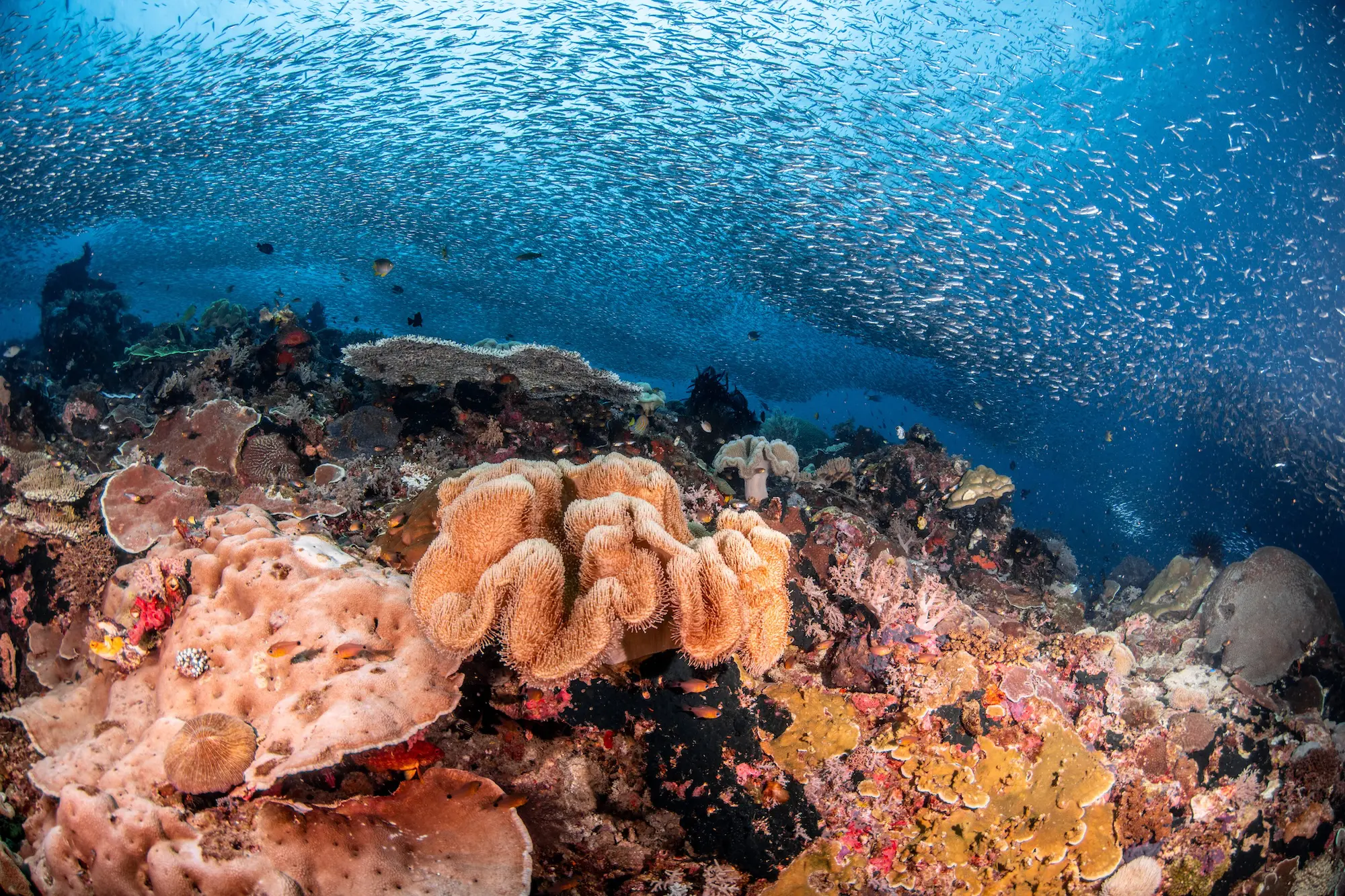
NOW OR NEVER – COLLECTIVE ACTION IS VITAL TO PROTECT CORAL REEFS
Coral reefs are all over the news this year.
As the climate crisis accelerates, they’re bleaching in the face of unprecedented heat, pushed to tipping points, and getting smashed to rubble in climate-induced storms. Some are then bouncing back stronger than ever in rare ocean refuges dotting the globe. Coral reefs are showing the world exactly what the unpredictability and danger of climate change looks like in real life, in real time.
Yet in the places where governments are supposed to work together to confront crises like this – climate talks under the Paris Agreement, biodiversity goals under the Kunming–Montreal Global Biodiversity Framework (KM-GBF), and national strategies meant to operationalize both – the planet’s coral reefs barely appear.
That mismatch should alarm us. Coral reefs are the rainforests of the sea, supporting 25% of ocean life. If our governments cannot integrate an ecosystem this visible, this valuable, and this vulnerable into their national plans, these frameworks run the risk of failing far more than just coral reefs.
Under the Paris Agreement, countries express their climate commitments and strategies through Nationally Determined Contributions (NDCs) and National Adaptation Plans (NAPs). Under the Convention of Biological Diversity, in accordance with the KM-GBF, countries set out their nature strategies and biodiversity targets through National Biodiversity Strategies and Action Plans (NBSAPs). Together, these plans guide national action, unlock funding, and protect ecosystems on the frontlines of change.
But new analysis from WCS, WWF, and partners released today at COP30 in Belém, Brazil finds coral reefs are all too often overlooked in national planning. The whitepaper, available now as a pre-print, reviews the 25 countries with the greatest coral reef coverage, revealing significant gaps in how these vital ecosystems are considered in policy.
WHAT WE FOUND
Coral reefs may be mentioned in passing, but they are not included where it matters – inside the targets and commitments that shape policy and financing.
- Unlike under the previous Aichi Biodiversity Targets, which had a target specifically mentioning coral reefs, no national biodiversity targets included coral reefs in headline text and very few NBSAPs contain measurable commitments to prevent the loss of coral reefs.
- Only one country, Papua New Guinea, has indicated plans to use coral reef indicators to measure progress on area-based conservation under the KM-GBF.
- Under the Paris Agreement, only 48% of these countries mention reefs in their NDCs, and only three (Belize, Fiji, UAE) include measurable commitments that could specifically deliver coral reef conservation in situ.
- Only five countries mention reefs in NAPs, despite reefs being one of the most important nature-based solutions to climate adaptation.
This isn’t a science gap. Countries understand that coral reefs are at risk and how critical they are, not only for the health of the ocean, where reefs anchor global marine biodiversity and buffer against climate impacts, but also for the hundreds of millions of people who depend on them for food, livelihoods, and cultural identity.
This is a governance and inclusion gap: a disconnect between global promises and the complexity of developing national plans for key ecosystems that are inclusive, adequately financed, and rights based.
We understand how this happens procedurally – not every country has coral reefs, so why should countries be required to set coral targets under the CBD? That was the logic of global frameworks. But what happens when so few of our high coral countries volunteer to set them, using those wide frameworks? That’s what we may find out.
Ultimately, this isn’t about the process. When coral reefs are missing from national plans, so are the Indigenous Peoples and local communities most connected to them. Without local leadership, equity considerations, and Indigenous knowledge at the center, we risk leaving behind the people who steward these ecosystems – a social problem as much as an ecological one.
THE GOOD NEWS: SOLUTIONS EXIST
The adage ‘better late than never’ is certainly applicable here.
We have the science and data; we have the tools. The next few years offer a tight window of opportunity to close the existing gap.
Here’s how:
- Governments and coastal communities can work together on national strategies and plans.
Recognizing that Indigenous Peoples and local communities living alongside coral reefs are key rights holders and partners, governments who have yet to design national coral commitments or strategies can work with them to protect tenure and resource rights, embed co-management in policy frameworks at all levels, and make planning far more inclusive for both science and traditional knowledge. In practice, this will integrate considerations of climate change. Together, we can identify high integrity, climate-resilient coral reefs at a national scale to guide conservation action and investment whilst reinforcing the local leadership that is already bringing coral reefs through the bottleneck of climate change.
- National partnerships can translate into contributions to global biodiversity goals, like 30×30.
Despite high-level political momentum to protect at least 30% of the planet’s ocean by 2030, many countries are still refining their national strategies for “30×30.” When pressures are reduced or removed, corals have been proven to recover, globally and locally. Climate-resilient coral reefs – those most likely to survive climate change – should be prioritized for protection. WCS is working around the clock on new science to help countries and communities identify 100% of these climate-resilient coral reefs, and our partners in the International Coral Reef Initiative (ICRI) have developed guidance for governments and their partners on integrating them into national biodiversity plans.
- Countries can channel climate finance to reefs to strengthen adaptation.
At present, climate finance vastly outweighs biodiversity finance, and finance for climate change adaptation is dwarfed by funding for climate change mitigation. This may be one reason that coral reefs, which can reduce coastal wave energy by up to 97%, rarely appear in climate commitments and strategies. However, including coral reefs as a natural climate solution in both NDCs and NAPs, particularly given their complementary role to ‘blue carbon’ ecosystems and indispensable contributions to many coastal communities, would unlock adaptation funding and elevate reefs as critical climate-resilient infrastructure.
Fortunately, our governments are not alone in this effort. A new political partnership, the High-Level Coral Commitment, launched at the 2025 UN Ocean Conference, is a growing intergovernmental pledge to take urgent action – with new signatures expected at COP30.
But follow-through is what matters. Without work on the ground to support co-management and rights-based governance, in partnership with Indigenous and community leaders, and direct climate and biodiversity funding to the people protecting reefs, we will keep seeing the same global disconnect.
Coral reefs are often framed as symbols of loss – but we see them differently. Around the world, reefs are proving more resilient than we imagined; they show how much is still possible to save and recover. Their absence across climate and nature plans today is a warning – but their survival tomorrow is a decision we are still making together.


About the authors
Alfred DeGemmis is the Director of International Policy at the Wildlife Conservation Society (WCS), with more than 14 years of experience in global conservation policy. His work spans biodiversity, protected areas and OECMs, wildlife trade, climate change, migratory species, food systems, and more. He serves as Vice-Chair for World Heritage under the IUCN World Commission on Protected Areas (WCPA), co-chairs WCPA working groups on topics such as OECMs, and has co-authored scientific and policy papers on topics ranging from protected and conserved areas to coral reef conservation and forest integrity.
Rachel JamesRachel James leads the Coral Reef Rescue Initiative (CRRI), driving global commitments for reef resilience and steering strategic partnerships for impact at global and regional scales. With 17+ years in marine science, policy, and conservation, Rachel champions Indigenous knowledge and climate resilience. She is a proud Siavun Clan daughter from Papua New Guinea.
Related content
 Four years to 2030: scaling effective ocean protection
 The legal fight for Europe’s marine protected areas
 A Turning Point for Ocean Protection in Ghana
Share this article
using #ForTheOcean