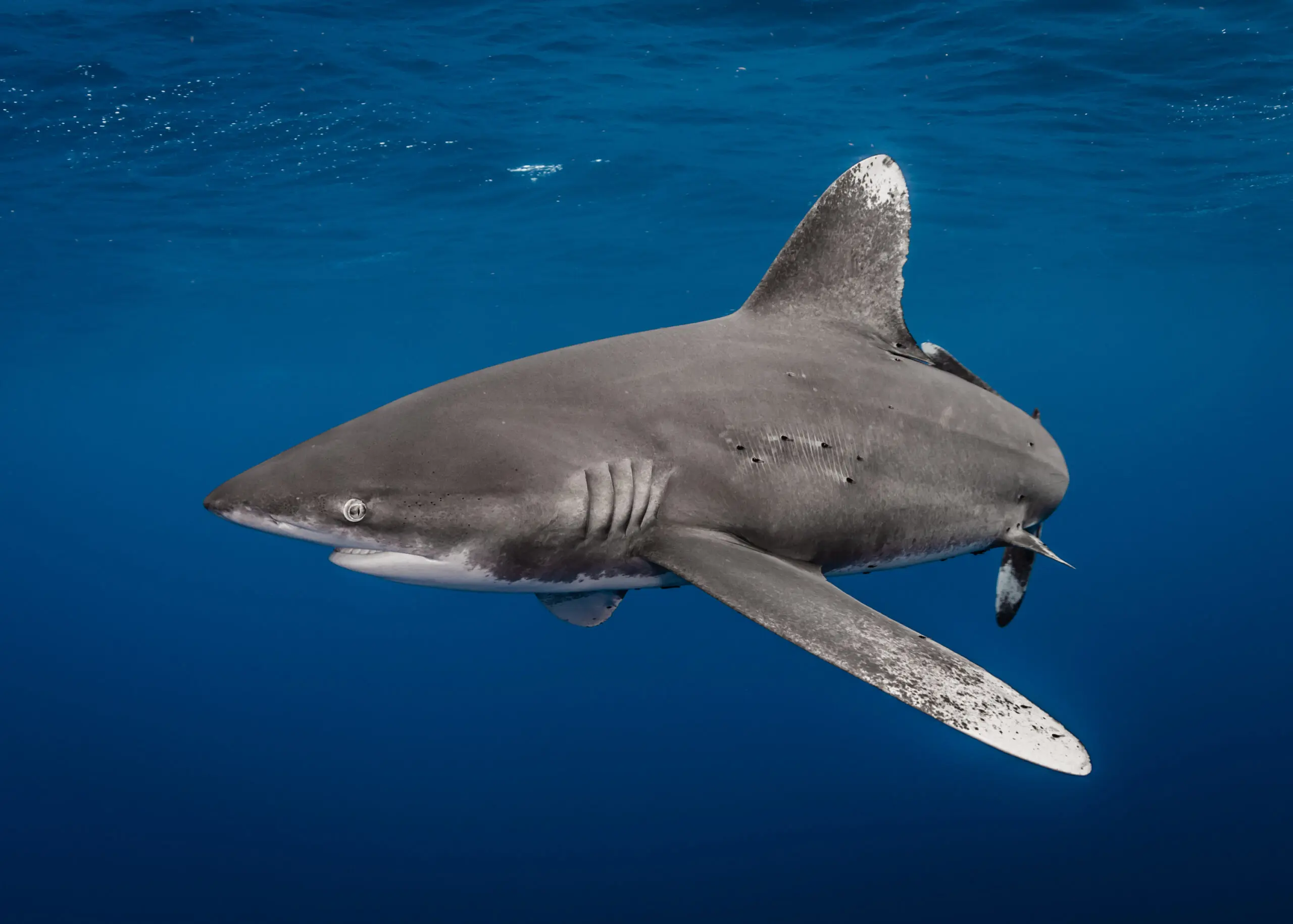
CITES delivered for sharks: Now 30×30 must carry protections into the water
CITES COP20 (the Convention on International Trade in Endangered Species of Wild Fauna and Flora) has officially come to a close with an array of key takeaways and outcomes to take stock of. CITES is an international agreement between governments aiming to ensure international trade in specimens of wild animals and plants does not threaten the survival of the species.
This year’s CITES COP20 marked a turning point for global ocean conservation. One outcome to celebrate is that, for the first time in the convention’s history, governments agreed to list a commercially traded shark species on Appendix I, effectively banning international trade for oceanic whitetip sharks. Also included in Appendix I were the charismatic whale sharks, manta rays, and devil rays, which support ecotourism operations in numerous developing countries.
Parties also approved zero annual export quotas, temporarily banning international trade for Critically Endangered wedgefishes and giant guitarfishes – the species attracting the highest prices globally in the fin trade – and extended Appendix II trade restrictions to dozens of additional species. It was the most ambitious suite of shark and ray proposals ever brought before countries, and every proposal passed. The overwhelming support for all proposals submitted for COP20, which together included more than 70 species, including the passing of three proposals by consensus, highlights the growing recognition by countries around the world of the need for concerted action and strengthened multilateral management and conservation efforts for sharks and rays.
WHY THIS MOMENT MATTERS FOR OCEAN CONSERVATION
Sharks and rays have been declining for decades: more than 37% of species are now threatened with extinction, pelagic shark populations have fallen by over 70% in the past half-century, and reef sharks are functionally extinct on one in five coral reefs worldwide. This has major ecological implications, not only for the persistence of the species, but also for the ecosystems as a whole, as sharks and rays play key roles throughout the food chain, from apex predators that control populations of smaller species below them, to scavengers who clean up the scraps. Overharvesting and excessive trade that lead to the loss of shark and ray species from their environments can thus have cascading negative impacts on the species around them, disrupting the entire ecosystem. The decisions just made at CITES show a global response finally beginning to match the scale of the crisis.
But this is not the only opportunity to mainstream shark and ray conservation. While the Parties to CITES are supporting trade restrictions, governments have an equally significant task before them in the next four years: to deliver the 30×30 goal – Target 3 under the Kunming-Montreal Global Biodiversity Framework to protect at least 30% of terrestrial and marine habitats by 2030 – in a way that turns paper protections into real in-water refuge.
This is where Marine Protected Areas (MPAs), and the global push to expand them under 30×30, become indispensable. Maintaining healthy ecosystems relies on a balance of all species within that environment, and marine sanctuaries or refuges need sharks and rays (and the ecological functions they provide) as much as sharks and rays need these refuges.
In the Western Indian Ocean, the gap between the potential for conservation gains under 30×30 and the reality of its implementation remains wide. A 2021 report showed that of the region’s 122 MPAs, few list shark or ray species as conservation targets, while fewer than 10 explicitly outline measures to protect sharks and rays. That means most protected areas in the region are not currently aligned with the species most urgently in need of refuge. As governments expand protections to meet their protected area targets, they have a once-in-a-generation chance to reverse this trend, before it is too late.
EFFECTIVE, SPECIES-FOCUSED PROTECTION IN MPAS
A powerful example of what effective, species-focused protection in MPAs can look like sits within one of the most important shark and ray hotspots in the Western Indian Ocean: along the border between southern Mozambique and South Africa. Underwater surveys by the Wildlife Conservation Society (WCS) show this ocean corridor is a haven for life: Critically Endangered white-spotted wedgefish, scalloped hammerhead sharks, sand tiger sharks, and other threatened shark and ray species thrive in these waters alongside massive, vibrant schools of pelagic fishes.
In this area, the Maputo National Park MPA – part of a UNESCO World Heritage Site declared in 2025 – has become a regional blueprint for exactly how an MPA can protect important species. Its success stems both from both the area’s ecological richness as well as outstanding local management of the MPA.
Inside the protected area, the management team has built a nationally-recognized program grounded in consistent enforcement, strong ranger training, and meaningful engagement with local communities. At the same time, management measures include large “total protection areas” where fishing isn’t allowed, and prohibit destructive fishing gears in some areas. The result is one of the few areas in the region where shark and ray numbers are holding strong, a real example of what effective protection in the right place can achieve.
This example shows what the future can look like if governments use 30×30 as a catalyst for species recovery. And the path forward is clear. To ensure MPAs deliver real protection for sharks and rays, governments should:
- Create or expand MPAs or other protections in areas selected based not only on important ecosystems or areas that would have the least impact on resource users, but in areas with the most important habitats for key species, with a particular focus on threatened species.
- Use existing science-based tools – including Important Shark and Ray Areas and Key Biodiversity Areas – to focus protection in areas important for shark and ray reproduction, feeding, migration, and aggregation.
- Design MPAs as part of a wider managed seascape, creating networks of connected MPAs, with well-managed buffer zones around core sites where destructive or high-bycatch fishing is restricted. Recent data show that MPAs can work for sharks – especially reef and coastal sharks – but that they perform best when surrounded by strong fisheries management rather than intense fishing adjacent to the MPA boundary.
- Invest in strong enforcement through trained rangers, community engagement and compliance, and monitoring that ensures MPAs provide real refuge rather than symbolic or ‘paper’ protection.
Momentum from CITES COP20 gives governments a rare opportunity. The world has never been more aligned on the need to protect sharks and rays. The same political will demonstrated at CITES COP20 can now flow directly into how countries shape and strengthen their protected areas. This is especially critical in the Western Indian Ocean, where many nations are still behind on their 30×30 commitments yet have some of the most important shark and ray habitats on Earth. Several existing frameworks in the Western Indian Ocean offer useful platforms through which effective MPAs can be implemented, including, among others, the Western Indian Ocean Marine Protected Areas Management Network (WIOMPAN), the Convention for the Development, Protection, Management and Development of the Marine and Coastal Environment of the Western Indian Ocean (Nairobi Convention), and the Western Indian Ocean Marine Science Association (WIOMSA) Science-to-Policy Platform.
If governments use 30×30 in the ocean to put species at the center of new protections, they can build MPAs that genuinely reduce bycatch and protect the most vulnerable life stages of slow-growing, long-lived sharks and rays.
The decisions made at CITES COP20 are just the beginning, not the end. By carrying this momentum into their 30×30 strategies, governments can ensure that protected areas become true lifelines for threatened species – and that 2025 is remembered as the year the world put sharks and rays on a path to recovery.
Header image credit: Shawn Heinrichs. CITES COP20


About the authors
For over fifteen years, Miguel Gonçalves has been Park Warden of the Maputo National Park in Mozambique, which encompasses the well-established Ponta do Ouro Partial Marine Reserve, an area known for its healthy shark and ray populations. Having a strong connection with nature and wildlife since childhood, Miguel has a strong understanding of both ecological and social systems, considering both as integral components in the successful management of a protected area. Miguel’s incredible efforts and successes within this Park have been recognized through several awards, including the African Ranger Award in 2018 – a prestigious award for rangers in Africa who “go beyond the call of duty in the battle against wildlife crime and play a pivotal role in protecting and conserving natural heritage and biodiversity.”
Rhett BennettDr. Rhett Bennett leads the Western Indian Ocean Shark Conservation Program at WCS. For the past eight years, Rhett has led WCS’s shark and ray conservation efforts in East Africa through a comprehensive, multi-faceted approach. His work has included advancing ecological and fisheries research to fill knowledge gaps on sharks and rays; raising awareness of national and international management measures; deepening understanding of sharks’ and rays’ conservation needs; and building capacity for accurate species identification and stronger enforcement of regulations. He has also engaged with fishing communities to promote more sustainable practices, while supporting governments to strengthen national policies, implement global commitments for shark and ray conservation, and tackle illegal trade in shark and ray products.
Related content
 30×30 is within reach – but the greatest gap is at sea
 Four years to 2030: scaling effective ocean protection
 The legal fight for Europe’s marine protected areas
Share this article
using #ForTheOcean